Beispiele
| 1. kubische Funktion |
a) Verhalten im Unendlichen:
`lim_(x->-oo) f(x) -> -oo` (`x^3`-Term ist negativ und wächst am schnellsten
`lim_(x->-oo) f(x) -> +oo` (`x^3`-Term ist positiv und wächst am schnellsten
b) Nullstellen:
`f(x) = 0 => 6 x *(x^2 - 2 x + 1) = 6 x * (x-1)^2 = 0`
`=> x_1 = 0`(einfach) und `x_2=1` (doppelt)
c) Monotonie und Extrempunkte:
`f'(x) = 18 x^2 - 24 x + 6`
`f'(x) = 0 => 6*(3 x^2 - 4x + 1) = 0`
Mitternachtsformel: `x_3 = 1/3; x_4 = 1`
| VZT | `x lt 1/3` | `x=1/3` | `1/3 lt x lt 1` | `x=1` | `1 lt x` |
|---|---|---|---|---|---|
| `f'(x)` | + | 0 | - | 0 | + |
| `G_f` | ↗ | HOP | ↘ | TIP | ↗ |
Extrempunkte:
`f(1/3) = 8/9` und `f(1) = 0`
HOP `(1/3;8/9)` und TIP `(1;0)`
d) Graph:
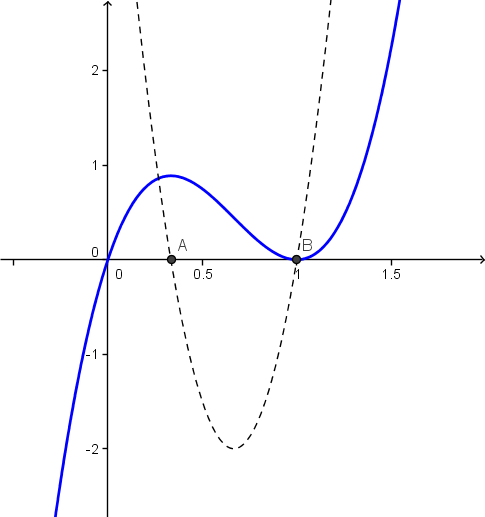
Monotoniebeispiel