Einige Grenzwerte
| Grenzwerte I | nach "Anschauliche Analysis 2":Baierlein, Barth, Greifenegger, Krumbacher |
`=lim_(u->oo)(ln e^u)/e^u = lim_(u->oo)u/e^u = 0` und
`=> lim_(x->oo)x/ln x -> oo`
| Grenzwerte II |
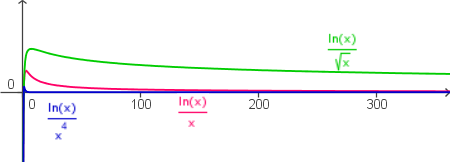
Vergleiche allgemein `x^r` mit `r in "IR"^"+"`:
`lim_(x->oo)ln(x)/x^r = lim_(u->oo) ln(e^(u/r))/(e^(u/r))^r = lim_(u->oo)(1/r*u)/e^u = 0`
Wachstum ln
| Wachstum der ln-Funktion |
Der natürliche Logarithmus wächst schwächer als `x^r` (`r in "IR"^"+"`):
`lim_(x->oo)ln(x)/x^r = 0` oder `lim_(x->oo)x^r/ln(x) -> oo`
"Der Logarithmus verliert immer!"
`lim_(x->oo)ln(x)/x^r = 0` oder `lim_(x->oo)x^r/ln(x) -> oo`
"Der Logarithmus verliert immer!"
| Grenzwerte III |
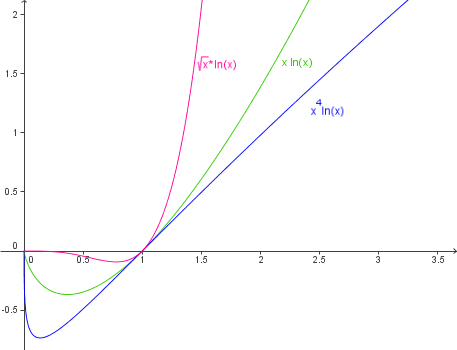
Noch besser:
`lim_(s->0+0) x^r*ln(x) = lim_(u->oo) (1/u^(1/r))^r*ln(u^(1/r)) = lim_(u->oo)(-r*ln(u)/u) = 0`
| Wichtiger Grenzwert |
`lim_(x->0+0) x^r*ln(x) = 0`
Produkt Potenzfunktion-ln(x)